Voices from the edge
Searching for Mandela. entry 5. Race relations transformed.

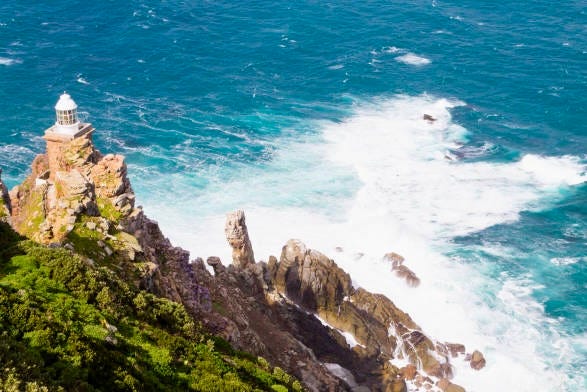
Cape Point istockphoto
Escaping the burdens of history we headed to Cape Point, windswept haunt of tourists and baboons. The Point is a slender blade of rock jabbing southwards, a sharp divide between the Indian and Atlantic Oceans. Up at the viewing area high above the lighthouse the whole place has an end-of-the-earth feel, with stomach-churning drops to the sea below.
And what a sea! Great swells came rolling in from the west and exploded against the cliffs. A full gale tore at me, fresh and lively after screaming across a few thousand miles of southern ocean, doing its best to blow me away.
Coward that I am, I cringed behind the stone walls that lined the viewing area and moved like an orang-utan on valium. Fear of heights is surely the most rational phobia of all. Fear of spiders? Phooey. Birds? Irrational. Only height and gravity have the potential to smash your skull like a rotten pumpkin and scatter vital organs across a wide area. Spiders simply lack the strength.
Peering over the cliff I looked down at the razorback ridge that led to the Point itself. As the gale redoubled in fury, I crept back to the car-park, where we encountered two Australians who entertained us with travel stories, alternating like practised TV newsreaders.
‘I tell ya this place is great. We’re havin a ball gettin all over.’
‘Yisterdie it was divin with sharks, y’know, great woites.’
‘Jeez mate, they put us in this cage and drop us over the side and y’know the bars are this bloody far apart!’
‘And it’s got no bloody top! And this great woite swims by and my legs are stickin out! Tell you I was shittin myself!’
‘So everybody charges the other end of the cage and it tips and my legs are stickin out even more!’
‘Yeah, and the bloody sheila that supposed to do the video was too busy yakkin and she missed it!’
‘Yeah! Jeez I was pissed off!’
‘Y’know on the woine tour those mountains they’re bloody amazin! They go straight up I tell ya.’
‘So this Cape Point? Right. Done. What’s next?’
‘It’s supposed to be some kinda National Park. Where’s the bloody animals?’
I suggested they visit Kruger or Kaligadi a thousand kilometres to the north.
‘Right mate we’re off. See ya!’
On the western side of the Cape Peninsula is Kommetjie beach, a four-kilometre curve of white. We visited to enjoy a sunset walk along the beach and feel sand between our toes. The place was almost deserted, which meant being alert to the possibility of a mugging.
A group approached us. We relaxed. It was a middle-aged white woman. Ash blonde, with two black girls aged about six and eight years.
‘What you doing?’ demanded the older girl.
‘Just looking at the sea.’
‘What’s your name? Mine’s Amanda.’ Her accent was expensively-educated South African English.
‘That’s a nice name’ I said.
‘Don’t go in the toilets. They smell.’
‘Thank you. We’ll remember that.’
‘Amanda, people don’t need to be told these things’ said the embarrassed mother.
‘Your children?’ I asked, unable to hide my curiosity.
‘Oh yes.’ Clearly she had given the explanation many times before. ‘My own are in their twenties now, so my husband and I thought why not adopt a new family? There are so many orphans needing homes.’
I commended her daughter’s confidence and we parted company.
The custom of middle-aged white couples adopting black children – some of them AIDS orphans – is not rare in the Republic. A couple of my own friends have done just that. Their girl is thriving. These adoptions are good-news stories without compare, tales of grace and goodwill.
During my travels I found that race relations had improved almost beyond recognition. Most black people seemed forgiving and patient and not at all interested in revenge. At a personal level I found the country transformed. Jeannie and I enjoyed open conversations with people in a way that had been impossible thirty years ago: Marta, Jonathan, Pieter, Thabiso and a hundred others; all were friendly and frank in their opinions.
We encountered the kindness of strangers and witnessed black and white and brown people interacting like normal human beings. Amazing! They talk to each other, they are respectful, they make eye contact, sit alongside each other at restaurants. Astonishing! Black, brown and white mingle without any fuss. Revelation! Given that South Africa had never been famed as the home of tolerance, this turnaround was hugely encouraging. I was surrounded by evidence of humankind’s adaptability and good sense.
Compared to the bad old days, this goodwill is a wonder to behold. The old master-servant relationships had vanished. The sullen resentment, the arrogance, guilt, suspicion, servility, edgy who-steps-aside-for-who dominance situations – all gone, dead, buried, perhaps forgotten. I’d half expected to find this kind of change, but to actually experience it was liberating. It was all so deliciously normal.
Does this transformation mean that racist views have vanished? Not exactly. Racist rednecks still exist but they keep a low profile. And here’s an example from media-guy Eric Miyeni’s book The only black at a dinner party: ‘It’s almost like the white people have a built-in mechanism to reject, ridicule, belittle and be disgusted by black people. As a result, black people find themselves being doubly disgusted by and hateful of the very same whites.’
Er, thanks Eric. But please clarify. Are you talking about most white and most black people? Or only a few? Or did you just make that up?
I came across men and women of all skin colours who live in fear of violent crime and who complained angrily about ANC corruption and incompetence, but can truly say that I never once heard anyone regret the death of apartheid. In fact the most concise words on the subject of apartheid were spoken to me by a white Afrikaans woman in Ceres. ‘It was a terrible mistake and it went on too long and now we’re all paying the price.’ Yep, that sums it up.
If you enjoy these Voices from the edge entries, please forward the link to any friends who may be interested in news and views from Africa.