Voices from the edge
Searching for Mandela. entry 7. Kirstenbosch and the VOC.

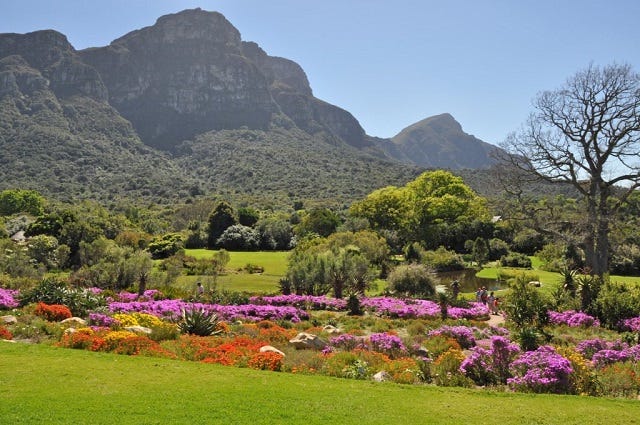
Kirstenbosch is perhaps the loveliest of the world’s great botanic gardens, a marvellous blend of human design and natural grandeur. Flowing down the eastern flanks of Table Mountain, its lower reaches have formal avenues, giant trees and clear mountain streams. We arrived to find lawns filled with the gladsome cries of a child’s birthday party, complete with balloons and a father organising complicated find-the-parcel games along winding stone paths. Kirstenbosch it is about as close as you can get to heaven on earth.
Down at the visitor centre a cluster of students and teachers – part of an environmental education course – lounged on the steps while discussing habitats. Black and white students chatted with no trace of self-consciousness. During South Africa’s grim apartheid years this kind of gathering would have been impossible. Blacks were told to study here, whites over there, and never the twain shall meet. In my own past the rare occasions of social mixing featured a blend of guilt and what the-shit-can-we-talk-about awkwardness. And now? Relaxed conversations about ecology. What a marvellous place this has become, I thought yet again.
It may not be immediately obvious to the casual visitor but Table Mountain is home to mind-boggling plant diversity, with more than twice as many native species as exist in all Britain. Plonk yourself down on any patch of ground and you’re likely to have several dozen different kinds of greenery within reach. Ericas, rushes, irises, and proteas dominate a vegetation type known as fynbos. Nature has been extravagantly generous in this one small corner of Africa, with around twenty thousand endemic plant species in the Cape Floral Region.
We wandered through Kirstenbosch enjoying its rich diversity, but also in search of a piece of history dating from 290 years before apartheid became cemented in place.
In April 1652 a group of men splashed ashore in Table Bay. Their leader, Jan van Riebeek, was an employee of the Vereenigde Oostindische Compagnie - known more snappily as the VOC - which had been established 50 years earlier as a rival to the London-based East India Company - making these two businesses the world’s first multinationals. Jan van Riebeek’s instructions were to establish a halfway station for VOC ships on their long haul around Africa to and from the spice islands of the east.
These spice-trading voyages were much further than a route via the Suez isthmus, but – and this may sound familiar – at the time there was Trouble in the Middle East. The new arrivals at the Cape were strongly advised to forget any colonial ambitions. Just grow cabbages and turnips so VOC ships could stock up at the halfway point and reduce the rates of shipboard scurvy, meaning that fewer dead sailors would have to be dumped overboard. It was business, that’s all.
Trouble was, people already lived around Table Bay, smallish light-brown folk whom the Dutch called ‘Hottentots’, a word that I discovered had recently become severely non-PC; so the original tribal name of Koikoi has been re-instated. The Koikoi home team was not thrilled. They were cattle farmers and not inclined to give up their grazing rights - but they were dealing with men who firmly believed in European superiority. Also, some of the newly-arrived Dutch quite liked living in warm and spacious Africa, so disobeyed the VOC and argued against returning to the Netherlands after their contracts expired. Cattle were stolen, spears thrown, guns fired, people killed. So van Riebeek ordered a physical barrier to be built, enclosing a few square miles for the VOC and providing a formal boundary to their tiny territory. This included planting a hedge of ‘bitter almond’ trees - although to be pedantic these were indigenous African trees, not almonds. The aim was to keep brown people out and Dutch cattle in. Historically this barrier became a forerunner of apartheid.
It failed. At Kirstenbosch a section of the hedge remains as a monument to futility. I climbed through its dark and gloomy tangle and found that its branches presented no great barrier to an average human or enterprising cow. Perhaps it was more solid back in the 1660s. The hedge is now a reminder that keeping races apart is a dumb unworkable idea.