Voices from the edge.
Searching for Mandela. entry 4. Back to the 1960s.

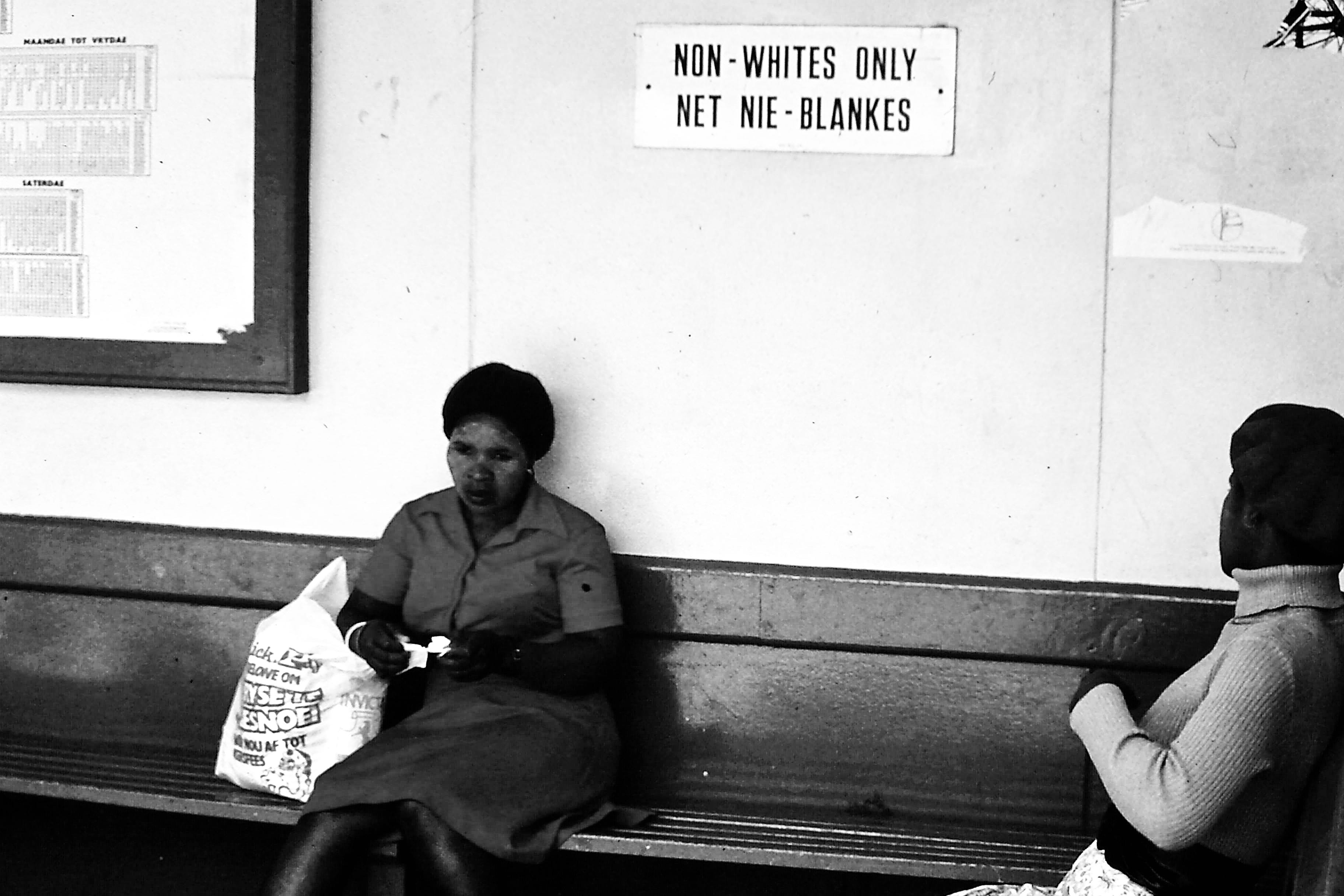
A glimpse of life in South Africa in Before times, and a brush with history. The photo above was taken on Rondebosch station in 1969. Signs such as these had all vanished by 1995.
In 1966 I was a graduate student at the University of Cape Town, living in a boarding house in a tiny dead-end street with the impressive name of Rustenberg Avenue, in a room so small and dingy that only students considered it fit for habitation. Hendrik Verwoerd, chief architect of apartheid, was Prime Minister.
In August a new tenant moved into a room recently vacated by me. He was a Greek by the name of Dimitri Tsafendas. To the dozen or so students he was a middle-aged loner with whom they had nothing in common. He was treated politely and kept at arm’s length. There wasn’t much “Hey, Dim, how’s it going?” – although he had impressive linguistic abilities and claimed to speak ten languages. He had a job as a messenger at parliament.
On the morning of 6th September he left for work with, as was soon to become clear, a sheath knife concealed on his person. As the bells were ringing for a parliamentary session to begin, Dimitri Tsafendas walked up to the seated prime minister and stabbed him in the chest, to the great astonishment of everyone in general and no doubt Dr V in particular, in the process setting an all-time standard for no-frills low-budget assassination. Verwoerd fell, gurgling out his last moments and creating unpleasant stains on the carpet.
Within hours, ten percent of the country was in mourning, ninety percent quietly rejoiced, and police stormed up Rustenburg Avenue to interrogate the students of Aldor Boarding House.
Their responses ran something like:
“Who, me? I know nothing about the man, never spoke a word to him.”
“Tsafendas is a weirdo, but I never guessed...”
“I mean, uh, we knew he was strange, but, I mean, I swear none of us ever believed he would.…”
“If only we’d acted on our suspicions and told the police.”
It’s not easy to say this kind of stuff without allowing a smirk to spread across your face and while you’re thinking “he had it coming”.
The situation was no joke. The South African judicial system was at that stage carrying out dozens of executions every year, all for offences far lower down the scale than Prime Ministerial assassination. This was clearly a hanging case if ever there was one.
Students at the University of Cape Town had never been renowned as loyal supporters of the apartheid government. A whiff of conspiracy could have led to an Aldor-ite dangling at the end of a rope, but after a few days it became clear that students were not only stupid (a fact long known) but also innocent of conspiracy to murder (a fact grudgingly conceded), and police left the inhabitants of Aldor Boarding House in peace.
Soon it became obvious to investigating psychiatrists that Dimitri Tsafendas was barking mad so he was declared unfit to stand trial. He died in prison more than twenty years later and is now regarded as a Hero to the Cause.
When apartheid ended in 1994 I could have stepped forward and claimed “Yes, it was me. I put Tsafendas up to it. Told him to stick a knife into Verwoerd.” But I never thought of this at the time. Stepping forward could have earned me a position in post-apartheid South Africa, perhaps even designation as a minor Hero to the Cause.
I did not think, so am not.
Nelson Mandela was at that time three years into his life sentence. As a banned person he could not be quoted or even referred to by the press, which in effect imposed an iron curtain of silence. Eventually news of the assassination reached the political prisoners on Robben Island. In his autobiography ‘Long walk to freedom’ (in chapter 68), Mandela later wrote: “Although Verwoerd thought that Africans were lower than animals, his death did not yield us any pleasure…. It (assassination) is a primitive way of contending with an opponent.”
In the 1990s, President Nelson Mandela re-entered the assassination narrative in a way that reveals something of his depth of character. He had a sympathetic correspondence with Betsie Verwoerd, widow. When they finally met at an official function, he gently helped her through her prepared speech – as she had mislaid her spectacles.
Next week: back to the 21st century.
My goodness, David! Thank you for these stories about your past. So interesting and well-written.