Voices from the edge
Searching for Mandela. Entry 9. Boyhood, political prisoner, statesman

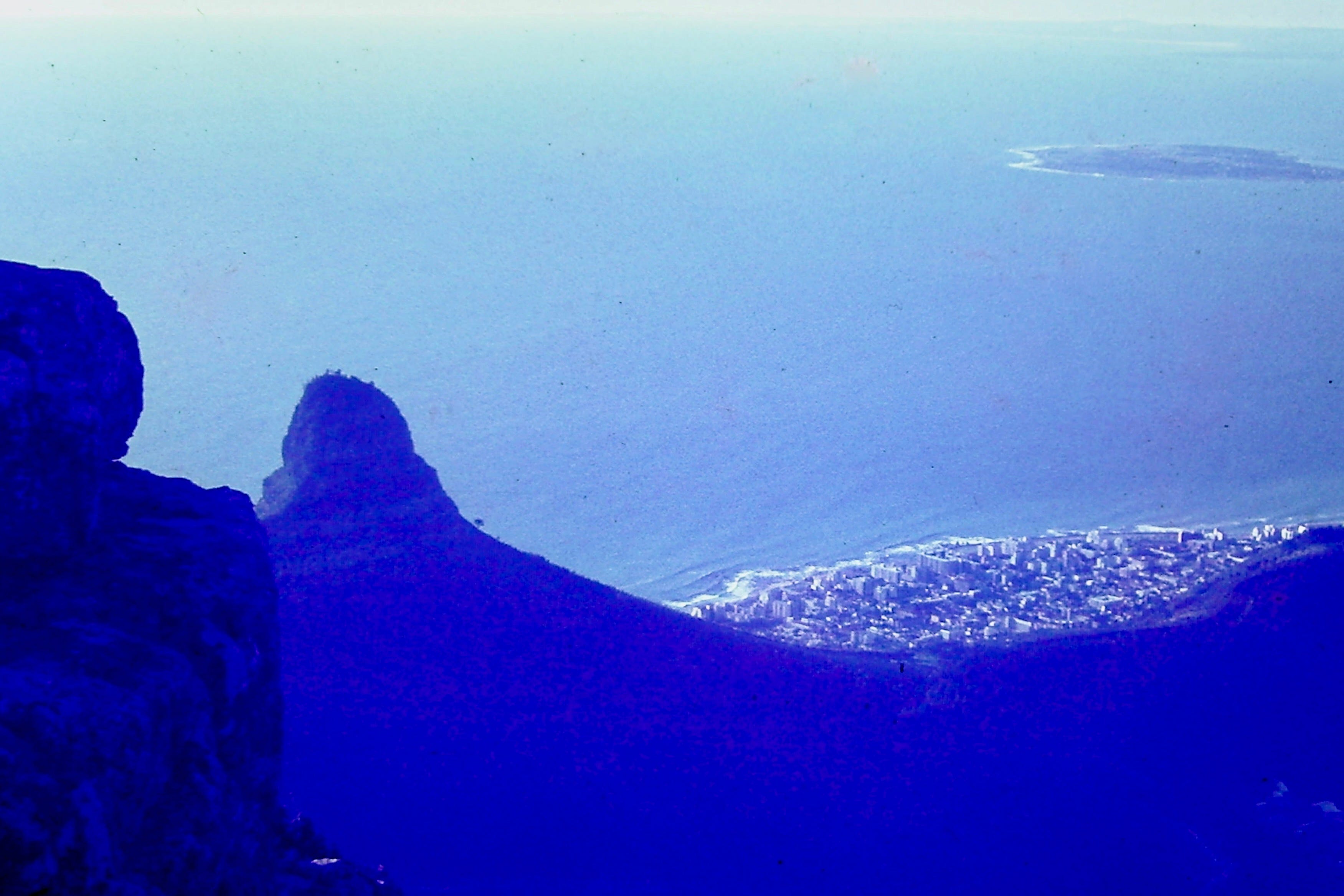
View from the top of Table Mountain. Lion’s Head on the left, Robben Island in the distance.
Seen from the top of Table Mountain, human problems fade into insignificance. Layer upon layer of mountains recede into the distance: Helderberg, Cedarberg, Winterhoek. Gaze westwards and you look out over a few million square kilometres of cold Atlantic. Robben Island floats like a biscuit in the blue of Table Bay. Its name is from the Dutch word for seals.
This little island became famous as a prison for political dissidents, none more famous than Nelson Mandela. A big chunk of his autobiography ‘Long walk to freedom’ deals with the tedium and brutalities of his eighteen years on Robben Island.
If prison authorities had been less stupid they’d have realised this island provided a perfect training-ground for the assembled revolutionaries. Mandela tells of one guard so lazy that once he’d marched his group to the quarry for rock-breaking duties each day, he ignored the prisoners completely and left them to their own devices so long as they caused him no personal trouble. Mandela and his companions used the opportunity to discuss politics, even organised their own university complete with lectures on ANC history and Marxist theory. In a few cases they made progress with the political education of white guards. In his autobiography, Mandela describes how he explained to one guard the ANC’s goals of equal rights and redistribution of wealth. The guard’s response: ‘It makes more bloody sense than the Nats.’
One chore for prisoners was the task of collecting piles of kelp that lay along the shoreline. Mandela describes the panorama of Table Mountain and the meals of crayfish he was able to harvest. Today, Robben Island symbolises the triumph of freedom over tyranny, and thousands of tourists take the ferry ride to the island to admire the view and be shown Nelson Mandela’s cell.
A whole stack of Nelson Mandela biographies have been written, mostly dealing with his part in the Struggle, his years of imprisonment, his political skills. Tom Lodge’s wonderful 2005 biography looks to Mandela’s boyhood to find the source of the man’s qualities, and shows how Mandela’s self-assurance and empathy were shaped by his upbringing. Given the name Rolihlahla (troublemaker), he followed the usual life of a herd boy from the age of 5 to 7, and his autobiography ‘Long Walk to Freedom’ (2004) paints a nostalgic picture o that place and time. Then his father died, and Rohlihlahla Mandela was adopted into a Xhosa royal household where life was governed by protocol and concepts of honour and virtue.
The young Mandela was groomed for leadership, which helps explain his aristocratic dignity and emotional self-control. Just as important, during his twelve years at mission schools and at Fort Hare University he experienced only positive encounters in his dealing with white people, and no personal humiliations. As a result he never developed the resentment that affected many of his contemporaries. In fact he later wrote in his autobiography ‘I became something of an Anglophile’.
Lack of bitterness helped Mandela survive during his 27 years of imprisonment and then deal with the incredibly difficult job of rebuilding the country and becoming South Africa’s guiding genius. He accepted white Afrikaners as people of Africa, and at his request the presidential home was re-named Genadendal: Valley of Mercy. Afrikaners were soon in awe of Mandela, and he in turn treated them with courtesy. Many used his respectful tribal name, Madiba.
Astonishingly, he appointed as his personal private secretary Zelda la Grange, a young Afrikaans woman who went on to work for him for 20 years. It was, as South Africans say, a hell of a thing. After the president’s term in office ended, Zelda continue to work with him as as executive spokesman for the Nelson Mandela Foundation, the gatekeeper whom everyone from Bono downwards had to woo if they hoped to have an audience with Madiba.
I wandered through the Mandela Museum at the Victoria and Albert waterfront, looking at displays of the apartheid years. The exhibits included photographs and stories of The Struggle, the pass laws, imprisonment without trial, the migrant labour system, destruction of family life, grinding poverty. The museum brought back realities that overlapped with my own past, but at the same time the experience was remote. I watched a visitor hold her hands to her mouth, her expression shocked. A pair of young museum employees chattered noisily and without pause, ignoring glares from visitors. Mandela-reverence did not rate with them.
One item jarred: the Mandela Museum’s repeated statements that freedom fighters were killed by the authorities, but that ANC operatives merely eliminated black policemen and suspected informers. I doubt that being eliminated is much more comfortable than being killed.