Voices from the edge
Searching for Mandela. Entry 8. Hout Bay: ask them to leave.

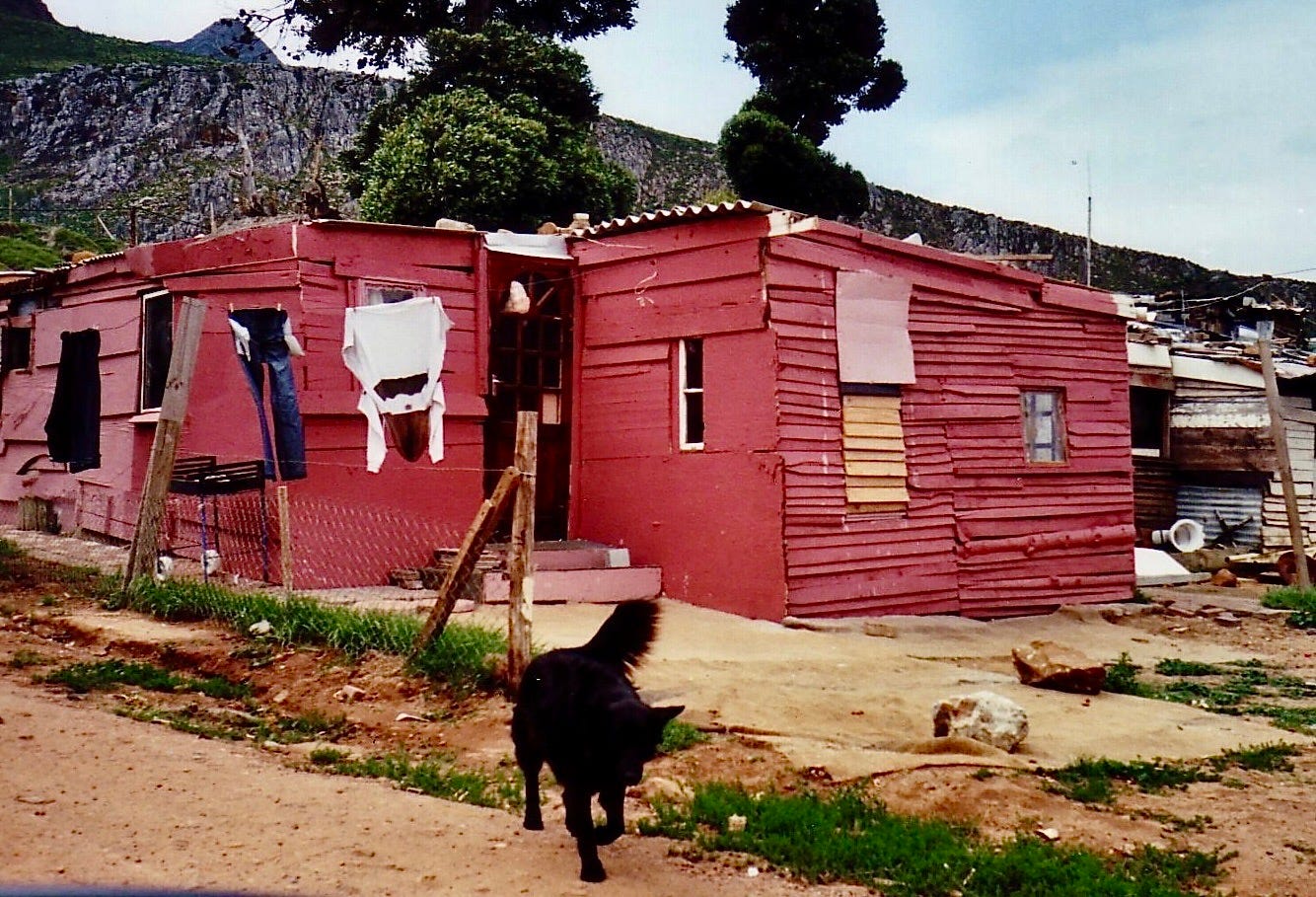
The road snaking around the side of Chapman’s Peak is both spectacular and dangerous – which makes it a handy metaphor for South Africa in general. At the northern end nestles Hout Bay, a curve of white sand with a picture-perfect fishing harbour sheltered by surrounding mountains. Previously this was a valley of spacious homes for the well-off, a genteel place where one could keep a pony for one’s daughter.
I now had to revise my preconceptions and align myself with modern realities. The mountains remain, but Hout Bay has developed into a microcosm of the new South Africa.
Mega-homes surrounded by razor-wire and high-voltage fences filled the valley, with tides of poverty lapping at the security gates of the rich. True, some of the wealthy homes now had black owners – a sign of changing times – but in the crowded townships that had spread up the hillside, every face was black. Huts were built of plastic sheeting and corrugated iron. The stink of sewage was everywhere. Clusters of unemployed young men sat and stared at passing traffic with the stare of pissed-off young men with too much time on their hands. In the cliché language of tourist guides, South African townships are often described as ‘vibrant’, but the day I visited Hout Bay nobody was vibrating.
We sat beside the shoreline and ate fish and chips in the company of seagulls. Hout Bay needed a rethink. The privileged sleepy hollow of forty years ago had developed a tangled mess of problems.
I wasn’t alone in my dismay. A few weeks earlier a feature covering the situation had appeared in the Mail and Guardian, so I use some of their interviews and quotes here.
Hout Bay’s problems began years ago when more people moved into the area than could be employed by the fishing industry. Most built ‘informal housing’ – the euphemism for shanties – in an area known as Imizamo Yethu, now home to 18,000 people.
‘This is probably the only place in the world where I can literally sit with my feet in human shit and my back against my R2000 shack, and look up to the mountains and across the valley onto a 3 million rand home and think: I live in a lovely place,’ says Priscilla Moloke. She was born in Hout Bay, runs a tiny shop at Imizamo’s Mandela Park, and has all but given up hope of owning land.
Conditions are horrible. Homes leak. Teenagers use tik (methamphetamine), few finish their schooling, many break into houses to steal. In 2004 Hout Bay suffered 754 crimes and 17 murders. All are affected: rich and poor, black people and white people and the coloured fishing community on the other side of the valley.
As black folk see things, land ownership in Hout Bay is central to the problem. At a recent ANC rally at Imizamo, a trade union leader urged people to take land from the wealthy. Local landowners see this as race hatred stirred up by lunatics.
The mayor of Capetown said that accusations of race hatred were false and there was simply not enough land, with a shortfall of 6,000 homes but physical space for only 2,000. The provincial administration promised that residents would be given title deeds to the land they already occupy, but the promise had not been kept. More people continued to arrive. In 2004 the Archbishop of Cape Town held meetings to address the development of Imizamo Yethu township. Mr Luthando Dolmiza, Communist Party Secretary, quite reasonably said ‘Hout Bay is extremely polarised because the difference between rich and poor is so stark. How can there be no racial tension?’
In the run-up to the 1994 elections, Mandela and the ANC promised that everyone would be given a rent-free home, with free electricity thrown in. Since then over two million basic homes have been built - a great achievement. However shantytowns continue to grow, sometimes hundreds of homes appearing on bare ground within a few days. The electorate clings to the ANC 1994 pledges, even though there’s little hope that Mandela’s ideals will be fulfilled any time soon.
Part of the problem lies in the sheer numbers. In the 1970s South Africa‘s total population was supposedly 15 million, but in truth there had never been a proper census so the number was no more than a guess. In 1994 the estimate was upped to 40 million. The 2007 total was estimated to be over 48 million, then 64 million in 2026, but those numbers exclude the millions of illegal migrants living on the fringes of society.
Whatever the true figures, there’s no doubt that the population had exploded. It had been raining babies. New homes and shanties were crowded into places that only a few years ago were far beyond the city limits, such as in the windswept valleys above Simon’s Town. In my absence the population had quadrupled.
In the M&G report on Hout Bay, Priscilla Moloke was given the last word. ‘I don’t know if the whites want us to leave. I’m going nowhere. Here I can walk to the beach and it’s a beautiful place. If there are too many of us, ask some whites to leave.’
If you have already subscribed to my Substack page, thank you very much. The present series “Searching for Mandela” will continue. If you have any feedback or suggestions, feel free. If you wish to look at any earlier postings, click on the thumbnail face image at the top and magically they will appear.
If you haven’t yet subscribed please consider doing so – there is no charge. No personal details or pin numbers are needed.