Voices from the edge.
Searching for Mandela. Entry 12

The Anglican church in Montagu was packed on the Sunday that Jeannie and I attended. I found comfort in the familiar liturgy, the Lord’s prayer, backside-pinching seats, friendly greetings. Visitors were asked to identify themselves and say where they were from. Us aliens from the other side of the world drew astonished reactions.
During the sermon the minister’s mobile phone rang. He answered it, held a conversation, then continued unfazed. Afterwards a woman came up to us and identified herself as a former New Zealander who’d passed this way forty years ago on her world travels, and found the place so wonderful that she’d stayed and put down roots. I could see why.
A day earlier we had ignored well-meaning warnings and set out to hike a river gorge that sliced through the mountains. As on many of our walks I took a hefty stick in case we encountered snakes or bad-tempered dogs – a precaution that turned out to be needed not even once in all our months of travel. The kloof was a lonely and beautiful place. Rocks, reedbeds, the sound of trickling water, the occasional alarm calls of dassies. But mostly silence. Then faint sounds of chanting reached us. At the base of an overhanging cliff we found a group of Muslims at prayer. They had walked a long way to be there but I could see why they had chosen the place, for its dramatic setting and acoustics. Jeannie and I sat down to wait until they had finished. They took no notice of us, but as they departed several of the women nodded their thanks for not interrupting their worship.
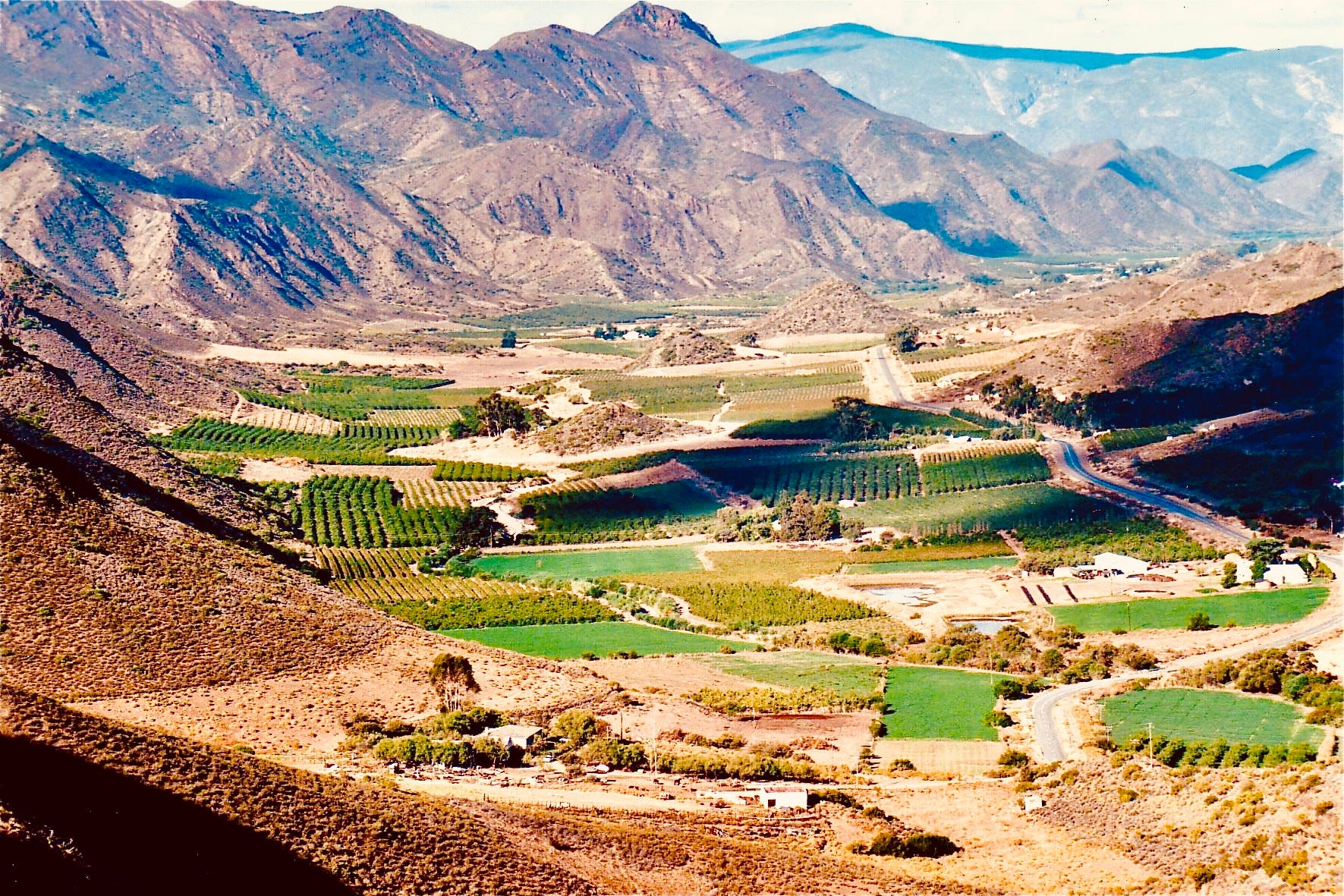
On a minor road leading north from Montagu we traversed a lovely valley, a stretch of land resembling some dream from a half-remembered paradise. It held a river, golden wheatfields, vines, orchards laden with peaches, with brown children playing around white-painted farmhouses, and the whole landscape surrounded by jagged blue mountains.
A cyclist came whizzing along the road, a black teenager in an electric blue shirt, his face filled with the joys of speed and of being alive in such a place.
‘I must get a photo,’ I said and braked hard, did a U-turn and stopped in front of him. I jumped out of the car, camera in hand, to find that he had dismounted and was in the process of turning his bike around. His open joie-de-vivre had been replaced with an over-the-shoulder expression of fear. Suddenly and with shame I realised what the situation was to him: an unexplained confrontation on a lonely road with a stranger who held in his hand an object that might or might not be a gun.
‘Moenie worry nie! Dis ‘n camera,’ I called out, waving it above my head to reassure him. ‘Kiekie asseblief? Can I take your photo please?’
He stood his ground, uncertainty all over his face, struggling to come to terms with the changing situation and trying to re-compose his features into a smile. I have his photograph in front of me now as I write these lines. It shows a young black man in an idyllic setting, his fleeting expressions revealing happiness, fear, uncertainty, relief, lost innocence – a moment frozen in time, a face representing an entire nation.