Voices from the edge
Searching for Mandela. entry 10. McGregor

These Substack entries contain conversations with ordinary people. They aim to give a portrayals of the new South Africa - with a blend of affection and regret. Feel free to pass on the link to any (former) South Africans.
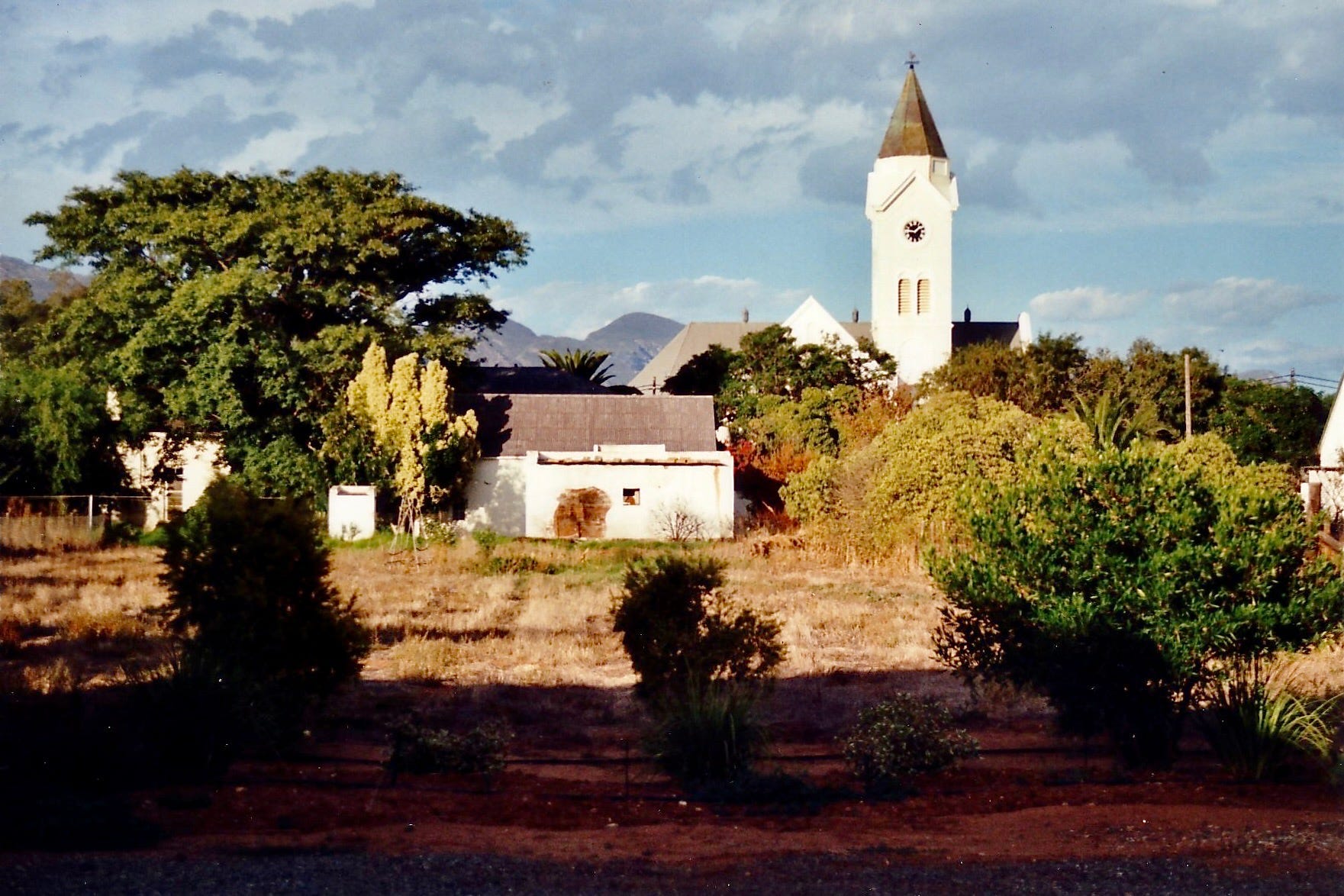
The town of McGregor is the epitome of a Western Province dorp: a dry rocky landscape ringed by blue mountains, a Dutch Reformed Church, clusters of white-painted buildings, a general dealer in a near-empty main street, a sense of isolation and slow living.
But some things had changed. SUVs were parked outside restaurants and I noticed art-and-craft shops, those reliable indicators of middle-class money on the move.
Some of the restaurant tables were occupied by tourists. These were ‘swallows’, a species I’d heard about but not yet seen at close range. Millions of seasonal migrants from England, Germany and the Netherlands have decided that southern Europe is too crowded, and chosen this corner of South Africa as the place to spend half of each year. It’s warm, beautiful, and cheap. A four-bedroom Georgian villa in McGregor probably costs about the same as a bed-sit in Birmingham, and the climate is incomparably better. I was told these swallows head north again each April.
Leaning on a front gate with a ‘Beware of the Agapanthus’ sign, the man looked as though he’d time on his hands, so we chatted. He was a retired plumber and bore a remarkable resemblance to General Smuts.
Was he a long-time resident of McGregor?
‘Nope. Retired here. Escaped five years ago.’
Escaped from where?
‘Jo’burg. Got out of the place as soon as I could. Forty years in hell was enough for me.’
So did he now live in paradise?
‘It’s OK. Nice and quiet. Don’t think I’d call it paradise though.’
What sort of problems did the town have?
‘Oh, drink, drugs, the usual. The young chommies drink way too much. At last count this town had thirty-two shebeens. Buy a drink and you’ll be offered methamphetamine. Plenty of it around.’
So why didn’t the police move in? I’d noticed five police vehicles parked outside the station just around the corner, surely an excessive number for a small town.
Ironic smile. ‘The police prefer to let sleeping dogs lie. They prefer to deal with more serious problems.’
Such as?
‘Not long ago a donkey-cart driver was fined for not stopping at our stop sign. Our police took a firm line on that.’
Houses were smaller and poorer in the eastern half of McGregor. Thin dogs nosed in the gutters and children stared at us from doorways. As the day’s heat lessened, groups of young women strolled along the roads in twos and threes, arm in arm, being eyed by men hanging around on street corners. An experience like this would have been impossible in apartheid times pre-Mandela, when palefaces like me were not allowed to wander around areas designated as black or coloured ‘locations’.
A battered-looking man fell into step beside Jeannie and I. He smelled of alcohol.
‘Naand meneer. My naam is Errol.’
‘Gidday Errol.’
‘Can meneer please buy my boat? I made it in prison. I made six in two years.’
It crossed my mind that a two year sentence implied that he probably hadn’t been convicted of homicide.
‘Please it is only one hundred rand for you special price eighty rand only.’
‘OK Errol. Show me your boat.’ I pictured a model of a fully-rigged galleon. We stopped outside a house where a huge woman sat breast-feeding at the doorstep.
‘You fetch it please’ I said, preferring my chances in the road to being mugged behind closed doors.
Errol re-appeared. His blocky little boat had two stick masts and was covered with thick layers of varnish. ‘The only tool they allow me in jail is sandpaper’ he apologised. Clearly there are limits to what sandpaper can accomplish.
I explained that his model could not possibly survive months of rough travel, offered him twenty rand for showing us his boat, and thanked him for his trouble. Errol seemed pleased with twenty rand and with the possibility of re-selling his varnished block of wood to some other visitor.
At a street corner we encountered three attractive young women, carrying clipboards and wearing identical tee-shirts with a logo.
‘Wat maak julle?’ I asked.
‘We’re getting stories from the old people’, one replied in English.
More discussion. It turned out they were being paid to collect oral histories before the older generation faded away. They weren’t sure if the results would ever get published, but it seemed to me a creative use of underemployed young talent
McGregor is a town where time has stood still, an historic gem far removed from the dangers and fears of the new South Africa. But I suspect that for many of its inhabitants it’s a place of poverty and alcoholism, a place where Errol and his friends can’t earn a proper living.
We set out before dawn to explore nearby Vrolijkheid nature reserve. We walked quietly along a dusty track in the low morning light, savouring the sharp aroma of desert shrubs and the drum-beat of dove calls. At our appearance a mongoose skidded to a halt then rushed away in panic. A scattering of quills showed that a porcupine had passed this way in the night. A pair of ostriches raced away from us, raising puffs of dust with each giant stride. A group of springbok watched from a distance. Five huge spurwing geese flew off with ponderous wingbeats when we approached their waterhole.
This karoo-like landscape was full of life. Death, too. A faint scent of something dead floated in the air. I bent down to examine predator shit in the dust. It was from caracal, the fur and crunched-up skulls revealed it had been eating mice.
This reserve wasn’t Africa of plains covered with big game. It was just an area of dry rocky hills but it sharpened my senses in a way I hadn’t felt for a long time. I’d almost forgotten the feel of places like this, sharpness coming from experiencing the boundary between safety and danger, and being in a place that reminds us that humans are only one part a world far bigger and older than ourselves.
By nine the sun had burned away the morning’s freshness, so we visited the conservation research centre nearby and chatted with a senior scientist. He told us that rainfall had decreased. The land was hotter and drier than before. Game farming was in vogue, but in order to attract European tourists and their lovely money, many farms had been heavily overstocked with wildlife; and the landscape was becoming badly damaged. Conservation was a low priority for the Government. Funding was being cut back year by year. This man loved the land and believed in what he was doing, but his pessimism ran deep.