Voices from the edge.
In search of Mandela. entry 11. Montagu

You are welcome to write your response in the comments section, and also to pass on this link to friends who are interested in travel. Or Africa. Or both. Registration is free.
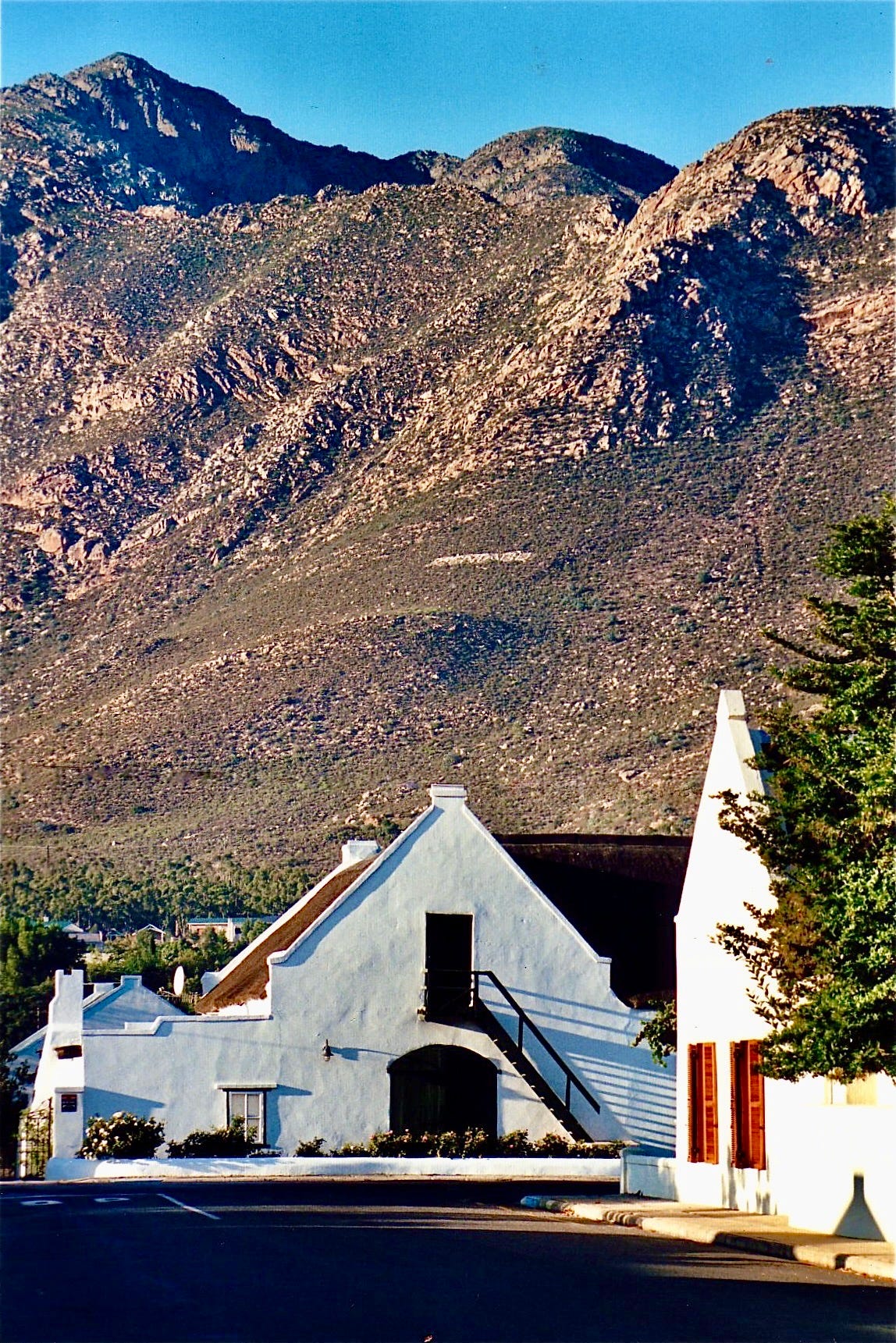
Cupped in its bowl of mountains, Montagu is a lovely town – especially if you stay among the historic-buildings and don’t look too closely at the poor side. I was discovering that even more than in the cities, the built fabric of race separation remains in place in small towns like this. In pre-Mandela times, apartheid laws decreed who lived where. Now, the ruling force is economics, whose laws are only slightly more flexible than Before.
Our bed-and-breakfast host couple were English and friendly. They’d fled Birmingham five years earlier, having made a number of exploratory trips before deciding on Montagu. The lady had firm opinions on the subject of migration.
‘We left because of gangs, crime, drugs, pressure. It’s not the England we once knew.’
What brought them to this place in particular?
‘Sunshine and good food. Almost everything is cheaper and the pace of life is so much easier.’
Were they swallows? Would they return home someday?
‘No. This is our home now and we have no intention of going back to England. My only problem is the heat. Over forty centigrade last summer.’
Her husband was baffled by poverty. ‘I mean, food is grown all round here, so why are people hungry? I just don’t understand it. My parents visited last year and they enjoyed everything but couldn’t understand why people are so poor.’
Maria, whom we met a few days later, could have enlightened them.
On the outskirts of town, homes and orchards pushed close against the mountains. We followed a narrow kloof, our trail starting in cool shade at river level then climbing upwards past cliffs and through fynbos. We encountered numbers of fellow-walkers: Irish, English, German, Afrikaans, and a couple from Melbourne who were currently living the good life in Cape Town and in no hurry to return to Australia. From above, the town of Montagu seemed insignificant, a tiny cluster of buildings in a mountain wilderness. High above soared a pair of black eagles, dark crosses against the blue.
Back down at the trail entry point at the end of the day we spent time chatting in Afrikaans with Maria*, whose undemanding job it was to enter the names of hikers in a book. While we talked, a big old leopard tortoise slowly laid an egg under the rose bushes. Maria was cheerful, shrewd, warm, more ironic than bitter at the circumstances she found herself in. Her sons were in their twenties and had never been employed. They had little prospect of finding work. One of her main concerns was to prevent them drifting into crime. Her husband was employed for only three months each year during the fruit-picking season. Their twelve-year-old daughter was unhappy at school because of racial taunts from white kids.
Had she complained to the principal?
‘Yes. But he can’t stop children from copying their parents.’
Even in the new South Africa?
She laughed. ‘Adults are more careful about what they say, but minds change slowly. Some white people here are still learning.’
I asked her whether she had ideas for increasing her family’s income.
‘Yes! I want to sell refreshments to the foreign tourists who come here to walk in the mountains. I know where they start and where they finish and what they want. I could do this easily and make good money.’
So why didn’t she?
‘I need a permit from the council.
Ah, the permit. Customs of the old South Africa were being carried forward. In the past, permits were needed for just about everything, and we lived under a top-down tradition of edicts which usually started with ‘The Minister Says…’ In Before times bureaucrats had to be appeased at every level, and their pleasure lay in saying ‘no’. Or if that didn’t work, they just ignored you. It seems that the post-Mandela administration was imitating the pre-Mandela regime.
So was there any special problem in getting a permit?
‘The council is black and I am coloured, so they will not give me a permit.’
I was surprised. She looked black to me, with dark skin and tight curly hair, but South African authorities had decided she belonged in a coloured racial group and not a black one. Yet again, those classed as coloured were being given the crappy end of the stick.
Could she run a street stall like those I’d seen in town?
‘Nigerians run most of the stalls. I cannot.’
‘Why not?’ I asked, having previously heard that some Nigerian migrants are widely feared. It seemed grossly unfair that men from a distant part of Africa could displace Maria, whose family had probably lived here for centuries.
‘A permit is not possible for me,’she repeated.
‘Could you perhaps just ask? Try for a permit?’
Maria shrugged. She assumed that an outsider like myself would never understand.
South Africa needs more people like Maria. She had brains, resilience, and good judgement. But her life was tough.
* not her actual name